

Why Write?
on the perks and pitfalls of a writing life

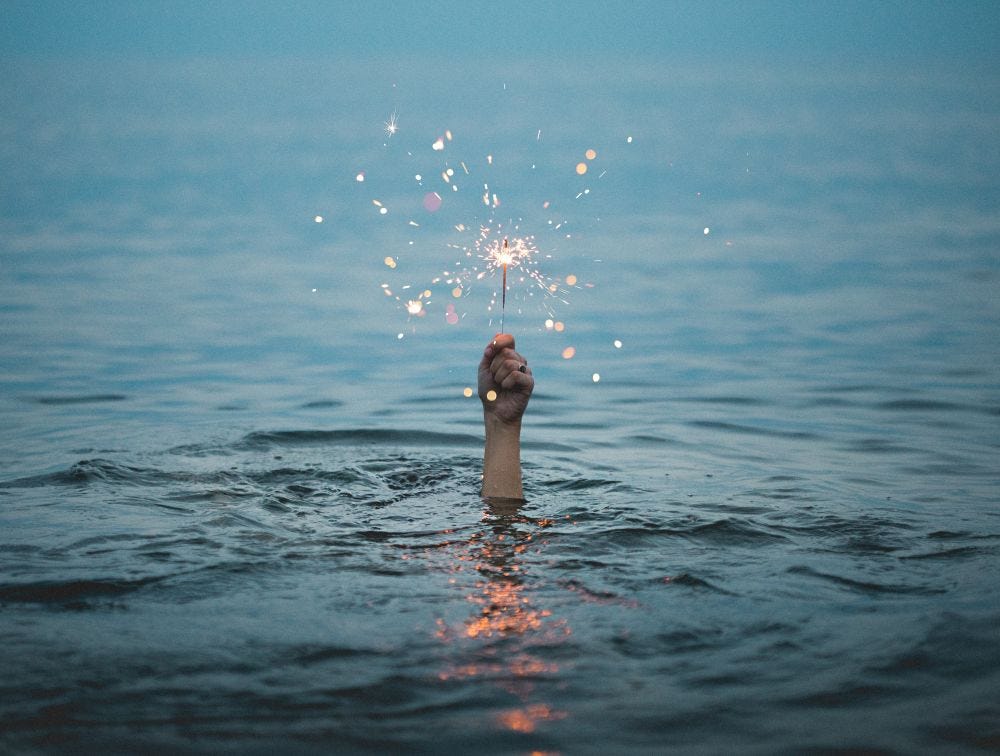
Do you ever question your choices in life? I do. It tends to happen in those down moments when I’m tired of the struggle, when the bills arrive and birthdays are imminent, when work screeches to a halt, and rejections flow in, or even worse, when there are no responses and I realise that something I’ve worked on for so long and with so much care has simply slipped through the cracks out there in this careless world. It’s then that I struggle to find the energy to keep going. And it’s then that I begin to question my choices in life and wish I’d taken up a more conventional career; one that I could put aside when I finished work each day and crucially, one that provided the safety cushions we all need - sick pay, holiday pay, superannuation and long service leave.
In these darker moments I feel the alluring tug of temptation. ‘Put it aside for now,’ it whispers in the kindest and most persuasive of voices. ‘Better still, give it up. It’s easy, all you have to do is . . . nothing.’
Why do I write? This is the question I always ask myself when I plummet into darkness. Reflecting on it helps me to reaffirm my motivations at a time when the writing life feels too hard, when I’m struggling with the idea of committing to a new project or when I’m finishing an old one. But we don’t need to be floundering in the depths of despair before we ask ourselves why we write. It’s an important question that helps us dig deep into ourselves and consciously explore the influences that have formed us and the motivations that drive us. It’s in these reflections that we can learn a great deal about why we’re drawn to particular genres and what themes we want (and often need) to work with. This kind of self-knowledge inevitably enriches our writing, and our lives.
I’ve always resonated with Ernest Hemingway’s take on why we write. ‘From things that have happened and from things as they exist,’ he said, ‘and from all things that you know and all those you cannot know, you make something through your invention that is not a representation but a whole new thing truer than anything true and alive, and you make it alive, and if you make it well enough you give it immortality. That is why you write and for no other reason that you know of. But what about all the reasons that no one knows?’
George Orwell identified his own motivations in his wonderful essay, Why I Write. ‘Putting aside the need to earn a living, I think there are four great motives for writing, at any rate for writing prose: sheer egoism, aesthetic enthusiasm, historical impulse and political purpose. They exist in different degrees in every writer, and in any one writer the proportions will vary from time to time, according to the atmosphere in which he is living.’ Then after flippantly suggesting that all writers are ‘vain, selfish and lazy,’ Orwell goes on to insist that ‘at the bottom of their motives lies a mystery’.
I love the way both Hemingway and Orwell hint at the mystery behind this question, because there is a mystery and it’s what draws us back again and again to the page, to the process. Perhaps it’s an addiction to this mystery, this magic, to the Imaginal Realm into which we all dip when we create. Perhaps it’s the sense too that the difficult process of writing is tempering us somehow, that the discipline it requires, the perseverance and the trust is enabling self-development. And then there’s the knowledge that writing itself is a creative journey of discovery, a coming to new knowledge about ourselves, the world in which we live and our relationship with it. As Flannery O’Connor said, ‘I write because I don’t know what I think until I read what I say.’
In her book, Negotiating with the Dead, Margaret Atwood asked herself why she writes and her answers reveal a refreshing humour and honesty, because in the end we all have more than one answer to this question. ‘To record the world as it is. . . To produce order out of chaos. . . To defend the human spirit and human integrity and honour. . . To make money so my children could have shoes. . . To make money so I could sneer at those who formerly sneered at me. . . To thwart my parents. . . To make myself appear more interesting than I actually was. . . Because an angel dictated to me. . . To amuse and please the reader . . . Because I was possessed. . . To subvert the Establishment. . . To celebrate life in all its complexity.’ In the end Atwood came to the conclusion that it’s pointless searching for a single reason when we’re such complex beings.
Should I Write?
Asking ourselves why we write is a question that can help us decide if writing is our true path.
If we don’t love immersing ourselves in the writing of others, if books aren’t our joy, our guides and our escape, and if we don’t feel irresistibly drawn to express ourselves in words, then writing is probably not for us.
If the sole reason for writing is money, publication and celebrity status, this isn’t a good foundation to weather the ups and downs of the writing life; unless we ask AI to write our stories for us, which strips away the process, devalues the product and undermines the creative effort and the sacrifices of all those who do not use AI. (For my thoughts on this, see my essay Process or product? What We Lose When We Let AI Write Our Stories for Us)
When I began writing, the economics of it didn’t cross my mind. If it had, perhaps I would never have stepped onto my path, because over the decades I’ve certainly suffered the consequences. Fewer than 1% of writers are traditionally published and very few (like Atwood) have financial success or receive funding to support their work. As a result, many writers choose to take matters into their own hands and self-publish, only to find that their books sink quickly into oblivion. It’s almost certain then, that unless we have other paying work (which makes writing even more difficult), we’ll struggle to afford the dentist or a new car when we need one. It’s likely too that we’ll have to live off lentils or the cheapest cuts of meat, dinners out will be rare and holidays a pipe dream.
Then there’s the fact that even with traditional publication, success is not guaranteed. Writing isn’t a well mapped career path with regular pay rises and promotions. In the writing world one published novel doesn’t necessarily lead to another, because success lies in the hands of a very few gatekeepers. Without that visible external success many of us will also have to put up with friends and relatives dismissing our writing with raised eyebrows and loaded questions. ‘Not published yet?’ Then on top of all this it’s likely we’ll have to weather hundreds of rejection slips or silences, and put aside our ego long enough to stomach (and welcome) criticism.
I’m trying to be honest here, not cynical, because despite all these negatives, if I had my time again, I might make some different choices, but I would still choose to write. Writing is a path. It has to be. Otherwise few would do it. And when something is a path, we’re drawn to it whether we like it or not. It’s not all bad. Not at all. In fact there are many rewards, though they’re not necessarily packaged in ways that society recognises and values.
Gratitude as a Way Forward
Sometimes when I’m down, I listen to those whispers of temptation telling me to let it all go. I even try flirting with alternatives. How could I live differently? I ask myself. Perhaps it’s a failure of my imagination but no matter how hard I look, I can never see myself in any other life. For all its tremendous ups and downs, writing is my calling and deep down I know that it’s futile to resist it. The only way forward then, is to keep embracing it. Reminding myself of this always helps me shift from self-pity to something more akin to gratitude. It’s gratitude that enables forward movement, fresh energy, and the right kind of attention. And it is gratitude, along with a fearless curiosity and playfulness, that enables the creative process.
In the end I write because I love writing. I love stories. I love the process of writing. The act of faith it entails. The mystery that Orwell and Hemingway speak of. In writing stories, in the forming of sentences and characters and plots, it’s possible to rediscover magic, to cast spells with words and to bewitch our readers. I love both the art and the craft of writing. I love the fact that writing is never boring; there are always challenges and there is always something more to learn. Then there’s the responsibility I feel as a writer, to myself, to my readers, to humanity, and to the earth itself, which sounds huge I know, but over time it’s become the foundation of my work. I’m immensely grateful that I have something to say and a medium through which to say it. Writing might be a challenging path but it’s also medicine. As novelist Gao Xingjian says, ‘Writing eases my suffering . . . writing is my way of reaffirming my own existence.’
Rosie x
PS: This essay explores why we write. In the next one (What are Writers For?) I’ll develop this theme further by expanding on the responsibilities we carry as writers.
Photo by Kristopher Roller unsplash
Everything on Alchemy of Story is free but I would very much appreciate it if you could support my work by clicking the heart button at the top of the page, restacking, recommending Alchemy of Story and passing the essays on to others. If you would like to help further I’ve set up a Buy Me a Coffee page where you can ‘buy me a coffee’!
I’m Dr Rosie Dub, a novelist and non-fiction writer, as well as a creative writing teacher, mentor and developmental editor. My PhD research explored the purpose and function of story as an evolutionary tool for individuals and societies. I’m also the creator of the Alchemy of Story workshop series.
For me the writing process is priceless, so I do not use AI for either the writing or editing of my articles or books. If you would like to read more about AI and the challenges it brings for writers and readers, have a read of this article: Process or Product? What We Lose When We Let AI Write Our Stories for Us
Thanks for reading Alchemy of Story. I would love you to subscribe so we can continue this conversation. Everything I post here is free. You’ll receive insights on how story and its elements work as transformational tools, the writing process and the nature of creativity, as well as writing tips, exercises and reviews of books that have changed the way I see the world.
This was a wonderful read, thank you. I've been in one of these down moments very recently, questioning absolutely every facet of every decision that brought me to writing and trying to do it as my main income, so to see it so plainly reflected back at me from someone else is honestly comforting. Writing can feel like such a solo endeavour most of the time, and then we trip over something that reflects our own experience so well. I also loved your quotes from Orwell and Atwood etc. some great insights chosen there as well! The Economics of writing is such a barbed subject, it can so quickly make the whole discussion around writing sticky and awful. And quickly bring on another of those "down" moments! Really loved this, sorry the comment is a bit scattered, I don't think my coffee has quite sunk in yet this morning. Anyway, great work!
A question I have been asking myself recently too. It’s like an invisible string that pulls you forward and before you know it you’re putting more words on to the page or absorbing them off the page of another. I really enjoyed your perspective as someone who is fully immersed and whose questions hold a similar but different set of parameters to my own. Thanks for sharing